Software Development - Outsourcing Methodology
(QMS-ISPL-M-SDM-O)
|
Version
No |
V20 |
Prepared by |
|
|
Date |
30-01-2015 |
Name |
Suman |
|
Signature |
|
||
|
Date |
30-01-2015 |
||
|
Copy No |
|
Approved by |
|
|
Issued
to |
|
Name |
Sai Prasad
Koneru |
|
Signature |
|
||
|
Date |
30-01-2015 |
||
Document Amendment Record
A- Added, M- Modified, D- Deleted
|
Sl.No |
Date |
Version
No |
Page
No |
Change Mode(A/M/D) |
Brief
description of change |
|
1 |
|
V01 |
N/A |
A |
Initial
Release |
|
2 |
|
V02 |
N/A |
M |
Section
7.7 & Section 9: Renamed Monthly
Reports to Metrics Analysis Report |
|
3 |
06-06-2012 |
V02 |
N/A |
D |
The Company address information is
removed from the Footer |
|
4 |
30-01-2015 |
V20 |
N/A |
N/A |
Reviewed and base lined |
Table of Contents
5. Entry Criteria,
Input, Activity, Output, Exit Criteria
7.1 Provision &
Monitoring of resources:
7.7 Maintenance of
Quality Documents
8. Quality system
documents referred
The purpose of this process is to
define the outsourcing methodology, which is followed for the software
development projects at Inooga for task based
outsourcing projects.
The Software Development Outsourcing
Methodology at Inooga follows either of the two
models:
Ø Project Based Outsourcing
Ø Task Based Outsourcing
The project based outsourcing
process adopts the standard software development life cycle of Inooga Solutions Pvt. Ltd.
The task based development life
cycle commences from the time a particular task is initiated by the customer to
the completed task delivered to the customer.
The objective of this process is to
define a standard process to be followed for all task based outsourcing model
of projects.
Software development outsourcing
methodology is applicable to all task based projects undertaken by Inooga Solutions Pvt Ltd.
|
Abbreviations/Terms |
Description |
|
CEO |
Chief Executive Officer |
|
CTO |
Chief Technology Officer |
|
ERP |
|
|
HR |
Human Resources |
|
MR |
Management Representative |
|
PC |
Project Coordinator |
|
PIN |
Project Initiation Note |
|
PM |
Project Manager |
|
PMO |
Project Management Office |
|
PMP |
Project Management Plan |
|
PR Tracker |
Problem Report Tracker |
|
SQA |
Software Quality Assurance |
|
WBS |
Work Breakdown Structure |
5.
Entry
Criteria, Input, Activity, Output, Exit Criteria
|
Sl. No |
Entry
Criteria |
Input |
Activity |
Output |
Exit
Criteria |
|
1 |
Requirement
of key skills for the project Resources
required for the project in terms of infrastructure |
Key skills
defined by the customer Resources
to be provided by Inooga |
Screening
of candidates by the HR team. Allocation
of resources for the project |
Selected
candidates Provision
and monitoring of resources for the successful execution of the project |
Issue
of appointment letter to the candidates Successful
completion of the project with the resources provided. |
|
2 |
Task
request |
Task
details |
Task
execution |
Delivery
of the work |
Customer
acknowledgement. |
|
3 |
Identification
of risks |
Analysis
of risks |
Monitoring
of risks |
Risk
Handling |
Risk
Mitigation |
|
4 |
Project
monitoring |
Weekly/
Metrics Analysis Reports, customer
satisfaction reports |
Monitoring
of project progress & customer satisfaction |
Customer
satisfaction survey reports. |
On
project completion |
|
5 |
Notification
of a problem |
Problem
description |
Problem
analysis and agreement with customer. Escalation
to the next immediate authority, in
case no solution is identified for the problem |
Solution
to the problem |
Problem
resolved. |
|
6 |
Programming
control |
Coding
standards as per the quality process |
Development
of the project related code as per the coding standards. |
Maintenance
of the project source code as per the coding standards |
On
Project completion |
|
7 |
Maintenance
of quality documents |
Identification
of the quality related documents for the project |
Preparation
and maintenance of the quality related documents for the project |
Identification
& traceability of the quality related documents for the project |
On
project completion with the required quality documents. |
|
8 |
Review
of the project by the SQA team |
Quality
related processes and data for the
project |
Execution
of the project as per the quality processes |
SQA
audit reports |
Ensure
closure of non compliances pertaining to the project. |
|
Sl.No |
Activity |
Responsibility |
|
1 |
Requirements management |
Customer |
|
2 |
Design & Development |
Developer/Project
Coordinator |
|
3 |
Project Management |
Project
Coordinator/Developer/Tester in coordination with customer |
|
4 |
Configuration Management |
Quality
Assurance Manager/Management Representative |
|
5 |
Risk Analysis & Mitigation |
Project
Coordinator/Developer |
|
6 |
Software Quality Assurance |
SQA
team |
The following activities are
performed in the task based development life cycle process.
Ø Provision & Resources Monitoring
Ø Task Life Cycle
Ø Process Monitoring
Ø Risk Monitoring
Ø Escalation Process
Ø Programming Control
Ø Quality Document Maintenance
Ø Quality Control
7.1
Provision &
Monitoring of resources:
7.1.1
Manpower: Keeping in mind the project
requirement, the key skills required for the team are defined by the Customer.
Qualified manpower will be identified by Inooga and
allocated to the project depending on their availability. In case the qualified
team can be staffed
from the available Inooga skills pool,
the resources will be allocated to the project. However, in case of non-
availability of the qualified team, the placement and recruitment and the HR
team coordinates the identification and recruitment of the required manpower.
The customer
7.1.2
Infrastructure: The
provide
the necessary infrastructure in three phases.
i. Initial project set-up
ii. During the course of the project
iii. Client visits onsite
i. Initial project set-up: The network
administration team discusses with the customer regarding the hardware &
software requirements and communicates with the CTO/CEO for approval. After
reviewing the feasibility of the requirements, CTO/CEO approves for provision
of the resources for the project. The project is initiated as per the Project
Management Process Manual defined for Inooga
Solutions Pvt. Ltd.
The HR team identifies the
required office space and available infrastructure and reserves the same for the project/process
development. In case the infrastructure is fully or partially not available in
the premises of Inooga Solutions, the General Affairs
department will provide the approved infrastructure following the purchase
process of Inooga Solutions.
ii. During
the course of the project: Apart from providing the necessary
resources, the network administration team also
iii. Client visits onsite: The
The following processes are performed during the
course of task initiation to the delivery
of task to the customer :
Requirements management
§ Initiate
the task
§ Analyze
the task
§ Estimate
the time & effort required.
§ Design
& Requirements Development
§ Prepare
test cases
§ Review
test cases
§ Perform
the task
§ Perform
testing
§ Deliver
the task
Project Management
§ Project
Monitoring
§ Risk Monitoring
§ Escalation Process
§ Programming Control
§ Quality Document Maintenance
§ Quality Control
§ Control of customer supplied property
Configuration
Management
Review
Process
Software
Quality Assurance
Given below is an overview of what each step
in the software development life cycle
process :
7.2.1
Requirements
Management
7.2.1.1 The
requirements for the project will be sent in a mail from the customer, are
result of an online discussion or are inserted directly from the customer in a
task tracker tool suitable and agreed
for the project. They form the basis for design and development activities. The
requirements gathering process is executed in the following cycle:
·
Customer discusses the requirement with the project
coordinator/developer and assigns the job to the developer through a task
tracker tool/mail.
·
Each task tracker item will be emailed both to the
project coordinator and task assigned person.
7.2.1.2 Analyze the task: The task is analysed for the purpose of clarity In case of any doubts, the project
coordinator/developer communicates with the customer regarding the task
requirements.
7.2.1.3 Design & Requirements Development: The
time and effort required to complete
the task is estimated and communicated by the customer to the
project coordinator/developer. If the
estimation provided by client is different to the self estimation of the project
coordinator/developer, then the same will be discussed with the customer either
by email/chat/voice chat/ phone.
If there is difference between the estimated time
and the time to be spent on fulfilling the task, the same will be reported in
the regular weekly project progress report to the customer. If a customer is
disagreeing with the reported time spent on the task the escalation process as
defined for the project will be used to solve the issue.
7.2.1.4 Prepare test cases: The
tester prepares test cases well before starting of the task.
(In
case a tester is not allocated to the project, the developer shall assume the
role of
the tester). The test cases may be changed during the life
cycle of the task until the task
is completed. In that way, the full requirements can be understood and the
customer may be contacted in case of any required clarifications. The Work
horse is generally used to maintain the test plans, test cases and test reports
pertaining to the project. In case any other tool is used to perform testing,
the same is mentioned in the project management plan.
7.2.1.5 Review test cases: The
tester reviews the test cases. The choice of the
tester will be determined by the Project Coordinator depending on the
task and the tasks will be entered into Work Breakdown Structure accordingly. This enables the tester to understand the full task
and to review the test cases.
7.2.1.6 Perform the task:
After acceptance of the task estimation by the customer, the team performs the
task as per the customer’s requirements by creating two tasks in the WBS.
i.
Coding the Task (Assigned to Developer)
ii.
Testing the Task (Assigned to Tester)
Code
reviews or walkthroughs may be conducted if required, depending on project
requirements. The tester may update the test cases again if
required, which are reviewed by the tester until the test plans are
satisfactory.
7.2.1.7 Perform Testing: The
relevant task is tested according to the reviewed test cases. In case of any
bugs, the tester reports the bugs to the developer until the task is complete
and without any bugs.
7.2.1.8 Deliver the task: The
completed task is delivered/intimated to the customer. The customer may or may
not acknowledge that the task is accepted. In case of non acknowledgement in
the defined acknowledgement time, it is assumed that the customer has accepted
the task. However, if the customer sends any changes to the task or rework of
the task, the above steps from 7.2.1 to 7.2.8 are repeated.
The Workhorse tool may be used to maintain the relevant documents.
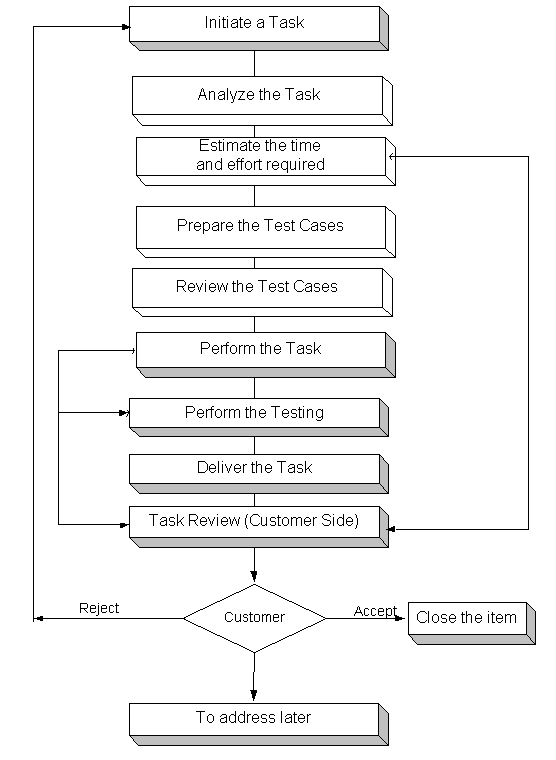
1.Task Life Cycle Process
7.3
Project Management
The progress of the project is monitored through the following means:
7.3.1.1
Day-to day communication: The team members interact with
Customer depending on the requirement, either through chat/phone/emails. Any
clarifications/aspects pertaining to the project are discussed with the
customer. Apart from this, the progress of the project is tracked through the
task tracker tool, using either PR Tracker or WBS of Workhorse. The tasks are logged at the initiation of the
task and updated on completion of the task.
7.3.1.2 Weekly Reporting: Weekly reports are sent by team members to the project coordinator on the last working day of the
week or defined day on a weekly basis. The project coordinator consolidates the
report, which is sent to the PMO who in turn mails a copy of the report to the
customer and the CEO/ CTO.
7.3.1
Customer Satisfaction Reports: A customer satisfaction survey
questionnaire is sent to the customer either half yearly or quarterly as mentioned
in the Project Plan by the Management Representative/Quality Assurance Manager.
An analysis of customer satisfaction is done based on the filled-in
questionnaire received from the customer and appropriate actions are taken to
ensure the customer satisfaction.
7.3.4
Monthly Reports: The project coordinator sends the Metrics Analysis Report of the project
report every month
to the MR/Quality Assurance Manager. In case of any commendations, complaints
or reports received from the customer, deviations to the quality objectives for
the project are also intimated to the quality department. These details are
reported and discussed by the MR/ Quality Assurance Manager in the management
review meetings. In case of any deviations or any other aspects pertaining to
process improvement/corrective/preventive actions are identified, and taken
care of.
7.4
Monitoring
Risks
The Risk analysis and mitigation process
available in the Quality Management Systems of Inooga
Solutions Pvt. Ltd is followed for handling of potential risks for the project.
The purpose of this process is to
Ø Identify the potential risks in
the project
Ø Plan to avoid, mitigate or manage
the risks
Ø Monitor the risks during project
execution
Ø Mitigate the risks during project
execution
Ø Handle the risks during project
execution
All the risks identified shall be managed to
avoid any obstacles in task implementation and ensure customer satisfaction.
7.5 Escalation Process
In case of
any problems pertaining to the project by the development team the diagram
below explains the process. The problem is first communicated to the immediate
authority, and in case the problem is not solved, is escalated to the next
immediate authority, and finally to the CTO/CEO before communicating with the
customer.
In case
the customer comes across any problems, pertaining to the project, the problem
is communicated to the project coordinator. In case of operational/infrastructure
problems pertaining to the project, the customer communicates with the
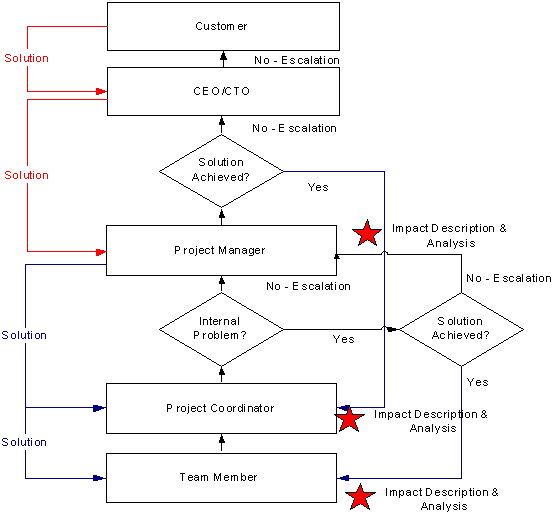
Figure 1:
ESCALATION
PROCESS FOR THE TEAM FOR TECHNICAL PROBLEMS
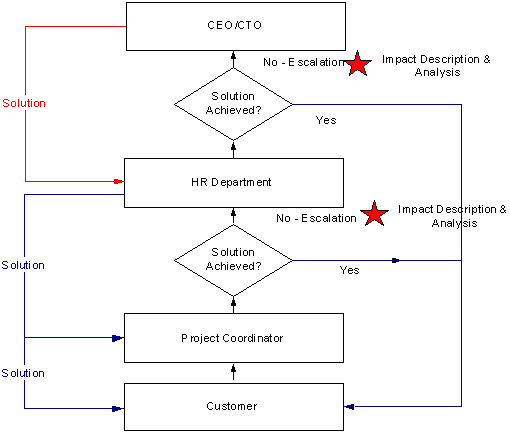
Figure 2: ESCALATION PROCESS FOR THE CUSTOMER FOR OPERATIONAL
PROBLEMS
The project team follows
development process/guidelines and coding standards as per the customer’s
requirements. Where such have not been provided by the customer, the project
team shall follow the Inooga Solutions Pvt. Ltd,
development process and coding standards and the related guidelines after
agreeing with customer.
7.7
Maintenance of Quality
Documents
The project team maintains the
quality documents as per the customer requirements. However, irrespectively of other
documents, the following set of records shall be maintained.
They are:
Ø Project Initiation Note
Ø Project Management Plan
Ø Review Records
Ø Weekly Project Progress Reports
Ø Metrics Analysis Reports
Ø Customer Satisfaction Survey
Reports
Ø Email/Chat correspondence with
the customer pertaining to project activities.
Ø Test Plans & Test Reports
Ø Project Closure Report.
However the quality records
maintenance process could differ based on the nature of the project. For ex: If
ERP based system, the test cycle will be slightly different, the process will
be mentioned in the PMP in detail. Some times this
process could take first three months to base line to achieve best quality, if
there is a not already predefined method from Customer side.
7.8
Software Quality
Assurance
The project is reviewed on
monthly basis by the SQA team. Any observations identified in the course of SQA
audit are closed within the stipulated period. In case of any non closure of observations,
these are escalated to the immediate authority to ensure that all observations
are addressed adequately.
8.
Quality system
documents referred
Review Process
Manual
(QMS-ISPL-M-REV).
Risk Analysis & Mitigation
Process
(QMS-ISPL-M-RAP).
Project
Management
Process
(QMS-ISPL-M-PMP).
|
Sl. No |
Required
Record |
Custodian |
Retention
Period |
Record
ID |
|
1. |
Project Initiation Note |
Project Manager/Coordinator |
Till the end of the project/Contract |
|
|
2. |
Task
Requests |
Project Coordinator/Developer |
Till the end of the project/Contract |
Task Tracker Tool |
|
3. |
Test Plans & Test Reports |
Project Coordinator/Developer/ Tester |
Till the end of the project/Contract |
Work Horse Tool |
|
4. |
Weekly Project Progress Report |
PM/PMO/Authorized person |
Till the end of the project/Contract |
|
|
5. |
Metrics Analysis
Report |
Project Manager/Coordinator |
Till the end of the project/Contract |
|
|
6. |
Project Closure Report |
Project Manager/Authorized person |
Till the end of the project/Contract |
|
|
7. |
Customer Satisfaction Questionnaire Form - for
Outsourcing Projects |
Project Manager/Authorized person |
Till the end of the project/Contract |