1 Introduction
1.1
Purpose
The software quality
assurance process provides management with appropriate visibility into the
various processes being used by the software projects/departments and for the
products being built.
1.2
Scope
The software quality
assurance process involves review and audit of the software
products/departments and activities. It is to verify that they comply with the
applicable process and procedures following the standards and to provide the
management with the results of these reviews and audits.
1.3
Quality objective
The objective is to
ensure that software projects/departments and activities adhere to the
applicable standards processes and procedures. Non-compliance issues are
reported and resolved.
1.4
Organization of the document
This document is
organized as follows:
·
Section 2 describes
the process decomposition diagram and the general description of the processes.
·
Section 3 describes
each of the processes separately in detail in terms of its activities,
objective, input, output, entry criteria, exit criteria, standard process and
procedures, control mechanism, approval and quality records etc.
1.5
Terms and Definitions
|
Abbreviations/Terms |
Description |
|
QMS |
Quality management system |
|
ISPL |
Inooga Solutions Pvt.Ltd. |
|
PM |
Project manager |
|
PMO |
Project Management Office |
|
PL |
Project leader |
|
PMP |
Project management plan |
|
SDLC |
Software development life cycle |
|
Software quality assurance(SQA) |
A set of activities designed to evaluate the process by which software activities are carried out and software work products are developed and maintained. |
|
Software work product(WP) |
These are outputs generated at various stages of software development life cycle (SDLC). These could be documents such as software requirements specification (SRS), design descriptions (DD), test plans etc., or software programs. |
1.6
References
Project management process manual
2
General description of the process
2.1
The process decomposition
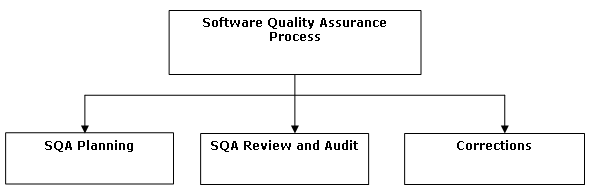
The software quality
assurance process comprises of implementation of the SQA planning, SQA review
and audit and reporting & corrections phases. The functional decomposition
diagram of the phases of software quality assurance process is shown below:
2.2
The process overview
The software quality
assurance process consists of the following sub-processes:
·
SQA planning.
·
SQA review and audits.
·
Corrections.
2.2.1 SQA
planning
The planning phase
involves identification of the SQA activities and schedules for conducting
reviews and audits.
2.2.2 SQA
review and audit
This phase involves
conducting the reviews and audits on the project’s activities and processes, as
per the plan, and reporting the observations.
2.2.3
Corrections
This phase involves
initiating corrections (if necessary), based on the observations of SQA review
and audit.
3
Specific description of the sub processes
3.1
SQA planning
3.1.1
Objective
The objective is to
ensure that all the activities for SQA review and audit are planned.
3.1.2 Entry
criteria
The PM/ PL/concerned
department head requests SQA manager for preparation of SQA plan.
3.1.3 Input
Projects
on hand.
All the departments
processes.
3.1.4
Activities
This sub-process
comprises of the following activities:
SQA Plan -
·
Identification of
frequency of SQA reviews and audits.
·
Identification of
resources for review and audits.
·
Schedules for the review
and audits.
·
Preparation of
checklists.
Participation in
preparation and review of PMP –
·
Consultation in the
preparation of PMP.
·
Review of PMP.
·
Verification to ensure
that the plans, standards and procedures are in place for SQA review and audit.
3.1.5 Output
SQA
plan.
3.1.6 Exit
criteria
The SQA plan is
prepared and released.
3.1.7
Standards and processes
Every
project/department process is taken for SQA review at least once in a month
and/or at the completion of a milestone. Based on the projects on hand and the
processes of the departments, SQA manager / authorized person prepares a monthly SQA plan. SQA plan identifies the
dates of review and persons responsible for conducting SQA reviews.
SQA plan is reviewed by
the concerned project managers/project leaders/department heads. After the
review, SQA plan is released for implementation.
SQA manager assigns one
QA representative for each project/department. It is the responsibility of the
QA representative to interact with the project manager/department head and team
members to ensure that they follow the standards, procedures and processes.
The QA representative
participates in the preparation and review of the PMP, standards and
procedures. As a part of this activity, QA representative provides consultation
to the PM/PL in the PMP.
The QA representative
reviews the PMP with respect to:
·
Compliance to the company’s process, procedures and guidelines.
·
Compliance to the standards and requirements specified by the customer.
·
Standards and process specific to the project.
·
Correctness and completeness of the PMP.
The QA representative
verifies that plans, standards, processes and procedures are in place and are
known to the team members. The plans, standards and process become basis for
review and audit of the project. In addition to projects, SQA team also
verifies process compliance of other processes once in a month and reports to
the concerned department head and SQA manager.
3.1.8 Control
mechanism
Project
managers/project leaders/department heads check for completeness of the monthly
SQA plan.
3.1.9
Approval
Management
representative/ person authorized by the management approve the monthly SQA
plan.
3.1.10 Quality records
SQA review observations
(QMS-ISPL-R-SQR).
3.2
SQA review and audit
3.2.1
Objective
The objective is to
ensure that the SQA review and audit is conducted as per plan and the QA
representative and PM/PL reaches a consensus on the observations that need to
be corrected.
3.2.2 Entry
criteria
The SQA review is due
as per the SQA plan or the milestone completed by the project.
3.2.3 Input
SQA
plan.
Checklists.
3.2.4
Activities
This sub-process
involves the following activities:
·
Conducting the SQA reviews and audits.
·
Reach a consensus on the observations during the SQA reviews and audits.
·
Record the reviews and audit observations.
3.2.5 Output
Report
of SQA reviews and audits.
3.2.6 Exit
criteria
The SQA review and
audit is conducted and a consensus is arrived on the observations of the
reviews and audits.
3.2.7
Standards and process
As per the SQA plan,
the QA representative along with the project team conducts SQA review and
audit. SQA review is conducted at least once in every month or as specified in
the SQA plan. SQA audit is conducted on the work product at the completion of a
milestone, as specified in the PMP.
As part of SQA review,
the QA representative interacts with the PM/PL and team members and evaluates
the activities against the PMP and designated software standards, processes and
procedures.
At the end of the
review QA representative identifies whether:
·
The activities of the
project comply with the process, procedures and standards of the project.
·
The project is
adhering to the schedules specified in the PMP.
·
The required documents
are prepared, reviewed and approved.
·
The required records
are prepared, indexed and filed for easy access.
·
Approval from the
authorized personnel is obtained in case of any deviation or changes made.
·
Observations from the
previous review are closed.
The SQA audit
observations are reported in the SQA audit and review observations record.
During the SQA review,
the Process Non Compliance Index (PNCI) is computed as a measure of the process
compliance in the projects/department reviewed by SQA. The process compliance
index is reported for management review.
The PNCI is computed
based on various parameters. The severity of the observations and the
parameters used for the computation of the PNCI of projects & functions are
as follows:-
·
For each of the
Critical, Major, Minor observations that are found, the Weightage
given is “10”,”5”,”1” respectively.
·
The observations that
are not closed since the last SQA review and audit are considered as Critical
by default.
·
If the update of the
record(s)/document(s) (as mentioned in the parameter section for
projects/functions below) is found to be pending in the SQA review and audit
for more than 7 days, then the severity is considered as Critical and not
Major.
Projects:-
|
Sl.No |
Project / Function |
Parameter |
Severity (Critical/Major /Minor) |
|
1 |
Projects
|
The required documents/records as mentioned below are not prepared / reviewed / approved: Estimation sheet/ PIN /PMP/ WBS/Timesheets/ Weekly project progress report/Monthly project progress report /SRS/Detail design/Software test plan /Test cases/Requirement traceability matrix/Customer satisfaction index/Metrics analysis report, If the naming conventions as specified in the QMS are not followed, If the Forms / templates/ records/ reports etc that are under usage are not from the current version as in the QMS. (Only applicable documents/records based on the frequency of preparation /review/approval are considered depending upon the current phase or type of the project) |
Critical |
|
WBS,Timesheets are not updated in the last 7 days |
Critical |
||
|
WBS,Timesheets not updated in the last 2 days |
Major |
||
|
If the below mentioned documents /records are found to be not updated in the SQA review and audit since last 7 days: Software test plan / Test cases / Requirement traceability matrix (Only applicable documents/records based on the frequency of their updating are considered depending upon the current phase or type of the project) |
Major |
||
|
Delay in the identification and traceability of the relevant records/documents/ Non maintenance of a proper directory structure/Any other activity/observations which does not have much impact on the execution of the process |
Minor |
Logistics Department
|
Sl.No |
Project / Function |
Parameter |
Severity (Critical/Major /Minor) |
|
1 |
Logistics |
The required documents/records as mentioned below are not Prepared/Reviewed/Approved : Inventory register/Service request register/Preventive maintenance register/Communication link status register/Backup register/Downtime analysis /Disaster management plan/Metrics analysis report
If the naming conventions as specified in the QMS are not followed, If the Forms / templates/ records/ reports etc that are under usage are not from the current version as in the QMS.
(Only applicable documents/records based on the frequency of their preparation/review/approval are considered) |
Critical |
|
Inventory register/ Backup register, Service request register not updated since last 3 days |
Critical |
||
|
The required documents/records as mentioned below are not updated since last 7 days: Preventive maintenance register /Communication link status register/ Downtime analysis / Metrics analysis report (Only applicable documents/records based on the frequency of their updating are considered) |
Major |
||
|
Delay in the identification and traceability of the relevant records/documents. Non maintenance of a proper directory structure/Any other observations, which does not have much impact on the execution of the process |
Minor |
HR & GA
Department
|
Sl.No |
Project / Function |
Parameter |
Severity (Critical/Major /Minor) |
|
2 |
HR & GA |
The required documents/records as mentioned below are not prepared/reviewed/approved : Offer letter/Appointment letter/Records of induction /Handover takeover/Training calendar/Record of training proposals/Attendance sheet /Training feedback/Training effectiveness/Individual employee training records/Skill database/Material inspection note/Evaluation of vendors
If the naming conventions as specified in the QMS are not followed, If the Forms / templates/ records/ reports etc that are under usage are not from the current version as in the QMS.
(Only applicable documents/records based on the frequency of their preparation/review/approval are considered) |
Critical |
|
The required documents/records as mentioned below are not updated since last 3 days: Offer Letter/Appointment letter/Records of induction /Handover takeover/Training calendar/ /Attendance sheet /Training feedback/ Material inspection note (Only applicable documents/records based on the frequency of their updating are considered) |
Critical |
||
|
The required documents/records as mentioned below are not updated since last 7 days: Record of training proposals/Training effectiveness/Individual employee training records/Skill database/Material inspection note/Evaluation of vendors/Material service requests (Only applicable documents/records based on the frequency of their updating are considered) |
Major |
||
|
Delay in the identification and traceability of the relevant records/documents / Non maintenance of a proper directory structure/Any other observations which does not have much impact on the execution of the process |
Minor |
Marketing Department
|
Sl.No |
Project / Function |
Parameter |
Severity (Critical/Major /Minor) |
|
3 |
Marketing |
The required documents/records as mentioned below are not prepared / reviewed/approved : Records of enquiries /Marketing progress report/Proposal, Contract records/ Work orders/Customer complaints / Commendations, Metrics analysis reports
If the naming conventions as specified in the QMS are not followed, If the Forms / templates/ records/ reports etc that are under usage are not from the current version as in the QMS.
(Only applicable documents/records based on the frequency of their preparation are considered) |
Critical |
|
The required documents/records as mentioned below are not updated since last 7 days: Records of enquiries/ Proposal, Contract review records, Metrics analysis reports (Only applicable documents/records based on the frequency of their updating are considered) |
Critical |
||
|
The required documents/records as mentioned below are not updated since last 3 days: Records of enquiries/ Proposal, Contract review records/Risk analysis report/Lost order analysis report, Metrics analysis reports (Only applicable documents/records based on the frequency of their updating are considered) |
Major |
||
|
Delay in the identification and traceability of the relevant records/documents / Non maintenance of a proper directory structure/Any other observations which does not have much impact on the execution of the process |
Minor |
Placement &
Recruitment Department
|
Sl.No |
Project / Function |
Parameter |
Severity (Critical/Major /Minor) |
|
4 |
Placement & Recruitment |
The required documents/records as mentioned below are not prepared/reviewed/approved: Records of Interview Rating sheet/Resource requests/Resource request tracker(Internal/External) /Communication with technical department for interviews /metrics analysis report
If the naming conventions as specified in the QMS are not followed, If the Forms / templates/ records/ reports etc that are under usage are not from the current version as in the QMS.
(Only applicable documents /records based on the frequency of their preparation/review/approval are considered) |
Critical |
|
The required documents/records as mentioned below are not updated since last 3 days : Records of Interview rating sheet/Resource requests internal/external) (Only applicable documents /records based on the frequency of their updating are considered) |
Critical |
||
|
The required documents/records as mentioned below are not updated since last 7 days : Resource request tracker (internal/external)/Metrics analysis report (Only applicable documents /records based on the frequency of their updating are considered) |
Major |
||
|
Delay in the identification and traceability of the relevant records/documents / Non maintenance of a proper directory structure/Any other observations which does not have much impact on the execution of the process |
Minor |
Computation of
PNCI:-
PNCI= ((No. of
Critical Observations * Applicable Weightage) + (No.
of Major Observations * Applicable Weightage) + (No.
of Minor Observations * Applicable Weightage))
Evaluation based on
the computation results:-
|
Sl.No. |
PNCI obtained |
Highlight/Conclusion
|
|
1 |
<=5 |
The function/project is following the process efficiently as mentioned in the respective process manuals but needs to show improvement gradually over a period of time |
|
2 |
>5 and <=15 |
The function/project is following the process, but not up to the mark. All Observations needs to be closed within a week’s time from the date of SQA audit. |
|
3 |
>15 |
The function/project is deviating from the process and hence a thorough audit has to be conducted fortnightly until the function/project is compliant. |
At the completion of
milestone, PM/PL informs QA representative to conduct SQA audit on the work
product. PM/PL provides the work product in soft copy or hard copy. QA
representative conducts audit on the work product.
At the end of SQA
audit, QA representative identifies whether the work product –
·
Is meeting the
requirements and standards for its creation.
·
Is reviewed and
approved by authorized personnel.
·
Is kept under document
control and/or configuration control (as appropriate).
3.2.8 Control
mechanism
SQA review and audits
are conducted as per SQA plan and PMP.
3.2.9
Approval
SQA manager reviews all
review and audit observations.
3.2.10 Quality records
SQA review observations
(QMS-ISPL-R-SQR).
3.3
Corrections
3.3.1
Objective
The objective is to
ensure that the review and audit observations are resolved and verification is
done on the resolved observations.
3.3.2 Entry
criteria
Department head/project
leader and team members take up resolving of the SQA review and audit
observations.
3.3.3 Input
SQA review
observations.
SQA audit observations.
3.3.4 Activities
This phase covers –
·
Rectification of
review and audit observations.
·
Verification of the
corrections.
3.3.5 Output
Resolved
SQA review and audit observations.
3.3.6 Exit
criteria
The SQA review and
audit observations have been resolved and verified by SQA.
3.3.7
Standards and process
The QA representative
conducts SQA review on the project/department activities and provides the
department head/ PMO/project leader with SQA review observations. Department
head/PL and team members take actions to resolve the observations. During the
subsequent SQA review, the QA representative verifies the actions taken for
resolving the SQA review observations and closes the report.
QA representative
conducts SQA audit on the work product at the completion of each milestone and
provides the project leader with SQA audit observations. Project leader and
team members take actions on the work product to resolve the observations.
Project leader informs QA representative regarding completion of corrections to
the work product. QA representative verifies the actions taken for resolving
the SQA audit observations on the work product and closes the report.
3.3.8 Control
mechanism
SQA manager keeps track
of the SQA review and SQA audit reports and ensures that the project leaders
resolve the observations. Any unresolved item is escalated to the concerned
authority.
3.3.9
Approval
SQA manager approves
closure of the SQA review and audit reports.
3.3.10 Quality Records
SQA review observations
(QMS-ISPL-R-SQR).
Plan for SQA activities
(QMS-ISPL-R-SQP).
Projects on hand
(QMS-ISPL-F-PRH).
4 Records
|
Sl. No |
Required Record |
Custodian |
Retention Period |
Record ID |
|
1. |
SQA Review Observations |
QA Manager |
N/A |
|
|
2. |
Plan for SQA Activities |
QA Manager |
N/A |
|
|
3. |
Projects on Hand |
QA Manager |
N/A |